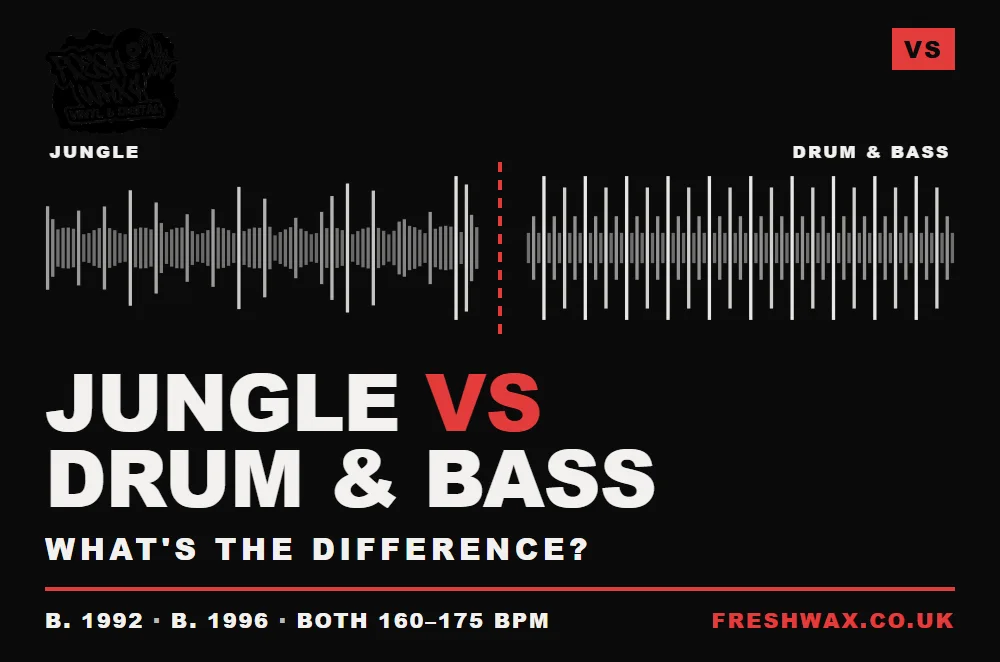
The short answer: jungle came first, drum & bass grew out of it, and the border between them is drums. Jungle (from about 1992) is built on sampled funk breakbeats — chopped, swung and human — with reggae bass and soundsystem culture running through everything. Drum & bass (the name took over from about 1996) streamlined that formula: tighter, machine-precise two-step drums, synthesised bass design and cleaner production. They share a tempo, a family tree and most of a record collection — which is exactly why people have argued about the difference for thirty years.
Why Everyone's Confused
There was never an announcement. No committee renamed jungle in 1996; one scene simply kept mutating, and somewhere along the way the new name stuck. The same DJs played through the whole transition, the same labels released both, and plenty of tunes sit exactly on the border. So three different claims all feel true depending on where you stood: that they're two names for one music, that D&B is what jungle turned into, and that jungle is a specific style that never stopped existing. The third one is closest to how the scene talks today — but the history explains why.
How Jungle Became Drum & Bass
By 1994, jungle was the biggest underground music in Britain — Top 10 crossovers, tabloid attention, the lot. The reaction inside the scene shaped what came next. Some producers went deep and atmospheric (LTJ Bukem's Good Looking camp, the so-called "intelligent" end); others went dark and stripped-back, trading chopped breaks for colder, harder two-step patterns — the sound that became techstep through producers like Ed Rush and the No U-Turn camp. Clubs like Metalheadz' Sunday Sessions at the Blue Note became the laboratory where the rebuilt sound was stress-tested.
As the ragga samples receded and the production got more engineered, "drum & bass" gradually replaced "jungle" as the scene's working name — partly natural drift, partly a fresh start after the mainstream moment and the baggage the media had loaded onto the word. By the time Roni Size & Reprazent's New Forms won the Mercury Prize in 1997, the industry knew the music as drum & bass. Jungle didn't die; it became the name for the breaks-forward, bass-heavy, soundsystem-flavoured end of the spectrum — and stayed there, alive, ever since.
Hear the Difference
- Drums. The clearest tell. Jungle rides sampled breaks — the Amen, Think, Apache — chopped and rearranged so the pattern dances and changes constantly. D&B favours the programmed two-step: kick, snare, ghost, snare, locked tight and engineered to the millimetre. If the drums sound like a drummer having an out-of-body experience, you're in jungle; if they sound like a precision machine, you're in drum & bass.
- Bass. Jungle's basslines come from reggae and dub — warm, melodic, rolling at half the drums' speed. D&B made bass a science: growling Reese basses, sculpted subs, sound design as the lead instrument.
- Voices. Jungle keeps the soundclash: ragga chat, sampled toasts, the MC as co-star. D&B uses voices more sparingly — soul hooks, atmospheric vocals — with the MC usually hosting rather than leading.
- Ethos. Jungle is collage culture: flipping records into new records. D&B is studio culture: original synthesis, engineering, loudness. Neither is better; they're different kinds of craft.
| Jungle | Drum & Bass | |
|---|---|---|
| Born | ~1992, UK rave + soundsystem culture | ~1996, evolved from jungle |
| Drums | Chopped sampled breaks, swung, ever-changing | Programmed two-step, tight, precise |
| Bass | Reggae/dub basslines, half-time roll | Synthesised bass design — Reese, engineered subs |
| Voices | Ragga samples, MCs front and centre | Sparser — soul hooks, atmospherics, MC as host |
| Feel | Rolling, swinging, rowdy | Driving, streamlined, engineered |
| Anthem | Shy FX — Original Nuttah | Ed Rush & Optical, Roni Size — New Forms era |
So Which Word Should You Use?
In 2026, drum & bass is the umbrella — the family name covering everything at 170, from liquid to neuro to jump-up. Jungle is two things at once: the origin story of that whole family, and a living style within it — the end that still chops breaks, still leans on the sub, still carries the soundsystem in its bones. Nobody sensible will correct you for calling a jungle tune drum & bass. Call a polished neuro roller "jungle", though, and a junglist somewhere will feel it.
Where It's All Going
The neat irony: after decades apart, the two ends are converging again. The 2020s jungle revival put chopped breaks back at the centre of dancefloors, and modern producers move freely between the camps — often inside one tune. You can hear that border-crossing all over Fresh Wax: Hangry Records' Jungle & DnB Vol.1 puts both names on the sleeve and both sounds in the grooves, 100% JUNGLE VOL. 2 plants its flag in the title, and the DJ mixes roll through both without asking permission. Browse the full catalogue and try drawing the line yourself — it's harder and more fun than it sounds.
Quick Answers
- Which came first? Jungle — early 1990s. Drum & bass emerged from it around 1996–97.
- Are they the same tempo? Nearly — both live around 160–175 BPM; modern D&B often sits a touch faster than classic jungle.
- Is liquid D&B jungle? No — liquid is a melodic drum & bass style. The jungle revival is its own lane, built on chopped breaks.
- Can one tune be both? Constantly — and some of the best ones refuse to pick a side.